

Author: Chris Marczak
Bullish Again
Summer is over, and the markets are bullish once more. Understandably, there’s a long list of concerns surrounding this renewed optimism. Some of these concerns are valid, some appear exaggerated, and others stem from a fundamental misunderstanding—of the market, and of its very nature.
The List
The key concerns remain largely the same: the national debt ratio, the inverted yield curve, and stretched valuation metrics are among the most cited. Then there are the more familiar refrains, such as: “This bull market can’t last forever.”
Sounds reasonable? Sure, it does. But something is often overlooked—the market’s capacity for irrationality. While analytical tools can certainly help improve our odds, their timing is notoriously unreliable. Markets can defy logic for prolonged periods, and predicting turning points remains one of the most difficult tasks in finance.
As Malcolm Gladwell notes in The Tipping Point, massive swings in collective human behavior often defy rational explanation. These are moments when herd mentality overrides logic—when psychology trumps fundamentals.
Technically Speaking
There may be many ways to interpret market behavior, but one indicator remains consistently reliable: a pattern of new highs is a strong sign of bullish sentiment. This principle comes directly from Dow Theory—and despite the passage of time, it continues to hold true.
Despite the dramatic technological evolution of the financial sector, the core nature of markets hasn’t changed much since Charles Dow’s era.
In fact, the overwhelming availability of information and easily accessible analytical tools can often be more misleading than insightful. Signal is frequently drowned out by noise.
At its core, investing remains fundamentally the same. If you don’t learn to live with investment risk, long-term success will remain out of reach. Fear and uncertainty will always be present—some based on valid concerns, others purely speculative. No matter how sophisticated your analysis or how well-informed your perspective, your ability to accurately predict a bear market is limited. And your chances of consistently identifying major turning points in long-term sentiment trends are virtually nonexistent.
With that in mind, reacting to every new concern or trying to outguess market sentiment based on fear-driven narratives is largely unproductive. The belief that closely following such fears will give you an edge is a dangerous illusion.
Another common misconception is that tracking “bad news” provides valuable learning. In reality, its educational value is questionable—especially when it clouds judgment with emotion. One of the most critical, yet most difficult, skills for any investor is the ability to accept losses.
Significant gains often require tolerating significant drawdowns. If you aim for meaningful long-term returns, you must develop the emotional discipline to sleep well even when your position is deep underwater. There is no alternative.
Finding Direction
One of the most frequent pieces of advice I offer during periods of market turbulence is deceptively simple: do nothing. In plain terms, this means: do not act just because you feel compelled to do something. Emotional reactions are often the most expensive ones in investing.
Market psychology is a treacherous force, often disguised in rational-sounding impulses. A common trap is to mentally calculate what you “could have bought” with the money that appears to have “disappeared” from your portfolio. This type of thinking is just another mask worn by the same emotional demon—regret, fear, and hindsight bias working against you. Don’t let it steer you off course.
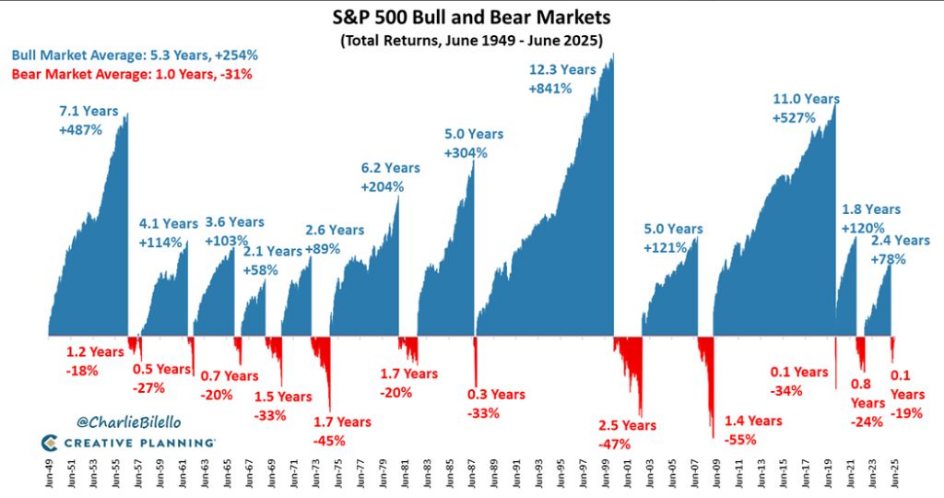 Temporary losses are part of the cost of long-term gains.
Capital doesn’t move in a straight line—it ebbs and flows. The real objective in investing isn’t to avoid every loss, but to ensure that, over time, your inflows exceed your outflows.
That’s the essence of success—not perfection, but consistency and discipline.
Risk Management vs. Emotional Reaction
So how does this mindset translate into effective risk management? Should you ignore market sell-offs entirely and remain fully passive? Not exactly. The distinction lies in whether your reaction is part of a predefined strategy, or just an emotional impulse disguised as action.
If your investment plan already includes specific responses to market drawdowns—such as rebalancing at predefined thresholds or reducing exposure under certain technical conditions—then those actions are strategic, not reactive. They should be executed with discipline.
However, if no such rules were in place from the outset, then making abrupt changes in response to market volatility often causes more harm than good. In those cases, the best course of action may be to do nothing.
Investing is both a science and an art. And acting outside your strategy in moments of stress is a sure way to kill the art.